7 min read
Vibe Coding in Laravel: AI Agents Need Guardrails
Vibe coding can speed up Laravel development, but only when AI agents work inside clear guardrails. I use Laravel Boost, Pint, Larastan, Pest, Rector, and review to keep responsibility where it belongs.

When people say vibe coding, some hear the future of software development and others hear technical debt. I understand both reactions. AI agents do save me time, but only when they operate inside clear rules, automated checks, and human review. Without that, speed can become a trap rather than an advantage.
This article is primarily about Laravel because that is where I have the clearest AI workflow and the strongest guardrails. But the principle is not limited to Laravel. It applies to other frameworks, to smaller Node.js or Python tools, and even to small applications built without a framework. The stack changes the shape of the risk. It does not remove responsibility.
Vibe coding needs responsibility, not fear
The naive version of vibe coding relies on a quiet assumption: if the model output looks convincing, it is probably correct. That is where the difference between a toy workflow and professional engineering begins. Code is not finished when it compiles. It is finished when it fits the architecture, handles edge cases, respects security boundaries, and can be maintained by someone else later.
That is why I do not interpret production vibe coding as “accept all” and “ship it”. That workflow may feel fast, but it pushes costs into review, debugging, and long-term maintenance. The model is not accountable for a broken deployment, a weak authorization check, or a migration that damages data. I am.
For me, the useful version of vibe coding is closer to assisted engineering. I can let the agent explore, draft, explain, and propose changes, but the final decision still belongs to the developer. The more explicit the checks are, the more useful the AI becomes.
Laravel gives the agent a safer operating space
I use Laravel as the main example because it offers a strong ecosystem: routing, validation, Eloquent, queues, scheduler, authentication, testing tools, Pint, Larastan, Pest, Rector, and Laravel Boost. These tools create a shared language between the project, the developer, and the agent.
That matters in vibe coding. When an agent generates code inside a framework, it has a better chance of staying within known boundaries: route, controller, request, service, model, migration, test. When I let the same agent work in a completely loose structure, I need to provide more rules myself. A framework does not make AI safe. It simply gives me more places where mistakes can be caught.
This is why I like Laravel for AI-assisted work. The framework already encourages conventions, and conventions are useful when a model has to reason about a codebase. They reduce the number of arbitrary decisions the agent can invent.
When I use a smaller stack without a framework
Vibe coding without a framework is not automatically a bad idea. For small tasks, it can be very effective. I sometimes use plain Node.js, Python, or an almost framework-free stack when I need a small tool with a narrow purpose.
Typical examples are:
a simple CLI script or one-off utility,
a small internal data-processing tool,
a quick parser, import, or export,
a proof of concept for validating an idea,
a small app without user roles, payments, or complex operations.
In those situations, a full framework can be unnecessary overhead. The important difference is scope. A small script with limited input, no sensitive data, and no long-term product ambition is a very different risk profile from a production web application with users, permissions, billing, queues, and integrations.
The less structure the stack gives me, the more explicit I need to be. I need a README, clear commands, basic tests, input validation, and a simple way to run the tool again later. Small does not mean careless. It only means the guardrails can be lighter.
What a real AI-assisted change looks like
The most useful AI workflow for me is not asking an agent to rewrite a whole feature. It is asking it to help with a small, well-framed change. For example, I might ask it to inspect an existing Laravel feature, find where validation happens, identify related tests, and propose the smallest change needed for a new rule.
A good agent can save time here. It can map the request flow, find the Form Request, point to the relevant policy, suggest a feature test, and draft the first implementation. But that draft is not the end of the work. It is the beginning of review.
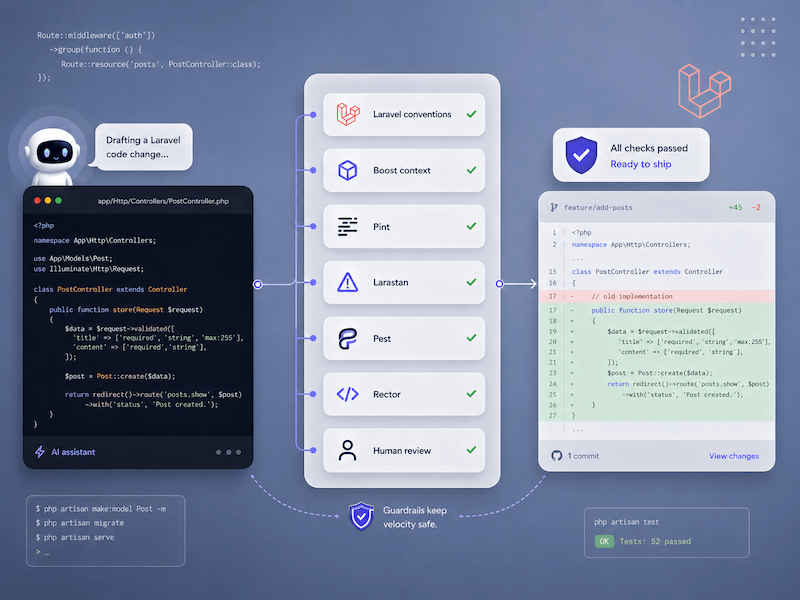
A realistic example: the agent adds a new field to a Filament form and updates the model. The code looks fine at first glance. Then Larastan points out a nullable relation that the generated code treated as always present. A Pest test catches that a user without permission can still hit a path. Pint cleans up style noise so the diff is easier to read. Rector may simplify a mechanical part of the change. Only after that do I review the actual behavior and decide whether the change belongs in the project.
That is the difference between using AI as a shortcut and using AI as a drafting partner. The agent moves the work forward, but the checks decide whether the work is trustworthy.
My guardrails in Laravel
In Laravel projects, my guardrails are relatively clear. Laravel Pint keeps style consistent. Larastan and PHPStan catch type problems, missing return values, and assumptions that would otherwise hide inside runtime behavior. Pest gives me feature tests, unit tests, architecture tests, and type coverage. Rector helps with mechanical refactoring and modernization.
I like splitting the workflow into two layers. The first layer fixes code where it is safe to do so. The second layer verifies that the change is acceptable before merge or deployment. In practice, that means commands such as:
composer refactorfor Rector and Pint fixes,composer test:refactorfor Rector dry runs,composer test:lintfor formatting checks,composer test:typesfor static analysis,composer test:type-coveragefor type coverage,composer test:archfor architecture rules,composer test:unitfor feature and unit tests,composer testfor the full verification pipeline.
This pipeline is the core of the workflow. It lets the agent move faster without making me trust it blindly. If the change cannot survive formatting, static analysis, type coverage, architecture checks, and tests, it is not ready.
Laravel Boost improves context, not responsibility
Laravel Boost deserves special attention because context is one of the biggest problems in AI-assisted coding. A generic model can guess how Laravel works, but guesses are fragile. They become even weaker when package versions, project structure, or framework conventions matter.
Boost helps by exposing Laravel-specific rules, documentation that matches installed package versions, and information about the application. That gives the agent a better starting point. It can reason from more concrete knowledge instead of producing code that only looks Laravel-like.
I do not see Boost as a magic layer that turns a model into a senior developer. I see it as a way to reduce avoidable mistakes. The responsibility still stays with me: read the diff, run the checks, understand the change, and decide whether it should ship.
The point is responsibility, not the framework
The critics of vibe coding are often right when they criticize blind AI usage. Copying generated code into production without review is not engineering. It is gambling with a better autocomplete. But dismissing AI completely also ignores the practical value it already has when used inside a disciplined workflow.
If I had to summarize my position in one sentence, it would be this: AI saves me time, but it does not remove my responsibility. Laravel is the main example here because it gives me strong guardrails, but the same thinking applies elsewhere. In a small Python or Node.js script, the guardrails may be simpler. In a production application, they must be stronger.
The future I care about is not blind vibe coding. It is closer to agentic engineering: clear intent, good context, small steps, automated checks, and a person who reads the diff and makes the decision. The framework helps, but responsibility is still the real boundary.
hub Related content
Related content
Additional content from this site connected to this article.
Laravel Boost
Laravel Boost starts to make sense when an AI agent should stop answering in general terms and work with a real Laravel application instead. It helps the agent understand package versions, routes, database schema, configuration, and documentation, so suggestions are less detached from the project. It is still only support for the developer, but in a larger codebase it can remove a lot of manual lookup work.
Rector
I see Rector as a tool for the point where manual refactoring stops making economic sense. It can scan a PHP codebase, apply mechanical changes, and help with language or framework upgrades without forcing a developer to hand-edit thousands of tiny details. Its real value appears when it is part of a controlled process, not blind automatic rewriting.
Laravel Pint
Laravel Pint solves one quiet but important problem: the team no longer has to keep discussing PHP code formatting. It is built on top of PHP-CS-Fixer, ships with sensible Laravel defaults, and works well both for local fixes and CI checks. Its biggest value appears when code style stops being a code review topic.
Larastan
I use Larastan as a way to bring static analysis into a Laravel project without ignoring Eloquent, facades, and the dynamic parts of the framework. It does not replace tests or review, but it can catch type errors, incorrect return values, and small problems that would otherwise appear only when the application is running.
Pest PHP
Pest PHP is a modern testing framework for PHP with a simple and readable syntax. It is not only a nicer way to write tests, but a tool that lowers the friction of testing regularly and fits naturally into the Laravel ecosystem. It helps most when tests are a normal part of development, not a separate chore at the end.
