Laravel Boost
Laravel Boost starts to make sense when an AI agent should stop answering in general terms and work with a real Laravel application instead. It helps the agent understand package versions, routes, database schema, configuration, and documentation, so suggestions are less detached from the project. It is still only support for the developer, but in a larger codebase it can remove a lot of manual lookup work.
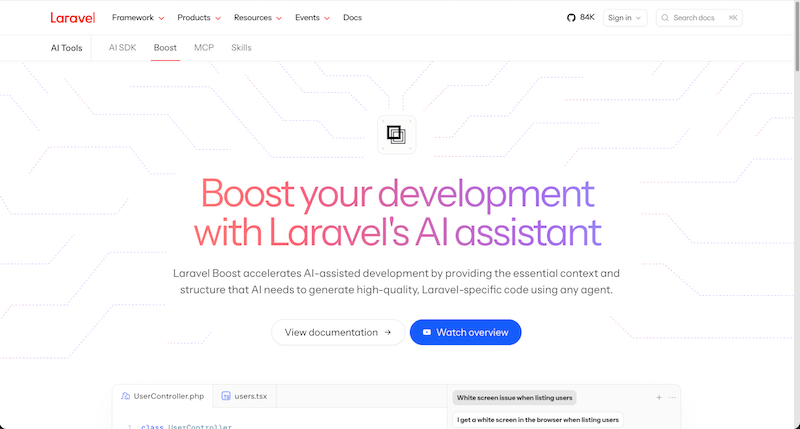
With Laravel Boost, the part that matters to me is not the AI hype itself. The practical question is simpler: does the agent understand the project it is working in? This is where everyday AI usage often starts to break down. A model can write Laravel code, but if it does not know the package versions, routes, database schema, configuration, or project conventions, it can easily suggest something that only looks right at first glance.
Laravel Boost tries to reduce that gap. It does not turn AI into a senior developer, and it does not move responsibility away from the person reviewing the work. What it does is give the agent access to information a developer would otherwise have to look up manually. In a small project, that may simply save a few minutes. In a larger codebase, it can be the difference between generic code generation and an assistant that at least understands part of the surrounding context.
Where Boost helps in practice
The biggest value appears when the agent should not only ask documentation, but also orient itself inside the application. I often need to know which models exist, how routes are named, what the database looks like, which packages are installed, or which configuration values matter for a specific part of the system. Those details decide whether a proposed change fits the project or feels like code copied in from somewhere else.
Boost uses an MCP server and a set of tools for the AI agent. Through those tools, the agent can inspect application information, database schema, routes, configuration, logs, and Laravel documentation. The official page also mentions support for database queries, Artisan commands, and Tinker integration. That does not mean I would let an agent run anything blindly. It means the agent has a better chance of working with facts instead of guesses.
Fewer generic answers
Without this kind of context, AI often drifts toward answers that are technically plausible but too generic. It suggests a pattern from documentation without checking whether the project already uses a different approach. It writes a migration without understanding existing relationships. It recommends changing a controller even though the application would be better served by an action class, a job, or a service.
Laravel Boost does not remove that problem completely. The developer still has to read the diff, run tests, and protect the architecture. But it can reduce the number of cases where the agent starts well and then wanders outside the project context. That matters more to me than the promise that AI can produce more code. More code is not useful by itself. Smaller, more accurate, reviewable changes are useful.
Guidelines, skills, and documentation
Another useful part is the way Boost works with guidelines and skills. I do not see them as a magic prompt that suddenly guarantees quality. I see them as a way to remind the agent of rules that would otherwise live in a developer's head or somewhere in internal project documentation. If a project has conventions for tests, class structure, Filament usage, or Laravel packages, it makes sense for the agent to know them before it starts proposing changes.
Documentation matters just as much. The Laravel ecosystem changes, and some answers depend heavily on the framework or package version. A recommendation that was fine two years ago may now be outdated or unnecessarily awkward. Boost helps the agent search more relevant documentation and package knowledge bases, instead of relying only on the model's general memory.
When I would reach for it
I would not treat Laravel Boost as the first thing every tiny Laravel project needs. For a simple website or a few CRUD screens, a clear prompt, tests, and a sensible review process may be enough. It becomes more interesting when an AI agent is a normal part of working with an existing codebase: refactoring, writing tests, tracking bugs, navigating routes, or making changes that touch several parts of the application.
It also fits well into a workflow that already has guardrails: Pint, Larastan, Rector, Pest, architecture tests, and code review. Boost does not guarantee quality on its own, but it helps the agent avoid starting from a blank page every time. That is its most practical value for me. It does not sell the idea that AI can work without a developer. It gives the developer a better way to keep AI closer to the real project.
hub Related tools
Explore similar tools
A random selection of tools from the same category.
Larastan
I use Larastan as a way to bring static analysis into a Laravel project without ignoring Eloquent, facades, and the dynamic parts of the framework. It does not replace tests or review, but it can catch type errors, incorrect return values, and small problems that would otherwise appear only when the application is running.
Laravel Horizon
Laravel Horizon is a practical layer on top of Redis queues in Laravel. It helps monitor job throughput, failures, runtime, and worker configuration, so queues are not just a process running somewhere on a server, but a part of the application you can actually observe and manage. It makes the most sense in projects where queues are used regularly and their state affects production.

Spatie
Spatie is best known for its long-maintained PHP and Laravel packages. In practice, I see it as a source of proven solutions for recurring problems: permissions, media handling, activity logs, backups, data objects, webhooks, and other application concerns. The value is not installing everything, but choosing the package that truly simplifies the project.
add_circle Missing a tool?
Suggest a tool for the list
If you could not find a useful tool here, send me its name and URL. I will review it and consider adding it to the public catalog.
