Laravel Sail
Laravel Sail is the official Docker development environment for Laravel. It helps run the application, database, cache, and other services without manually installing the whole stack on a developer machine. It makes the most sense when you want a fast project start and a consistent local environment across the team.
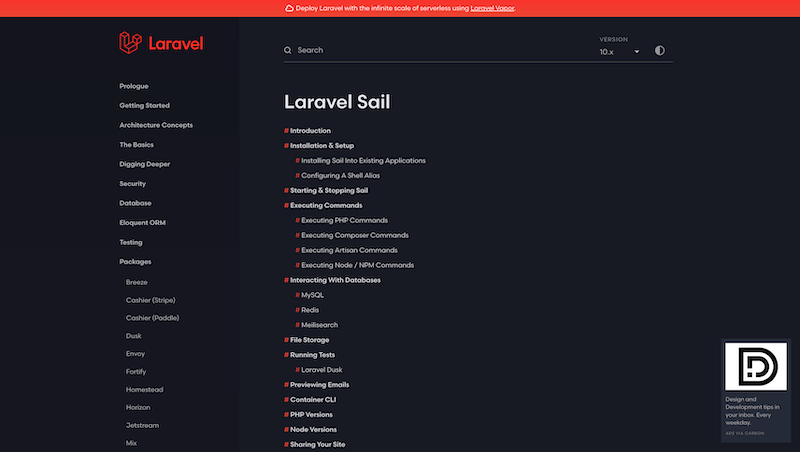
Laravel Sail solves a very practical part of development: how to run a Laravel application locally in a fast and repeatable way. Installing PHP, a database, Redis, Mailpit, and other services manually can work well when there is one developer. Once a team, multiple machines, or frequent project switching enters the picture, local environments start creating unnecessary differences.
Sail builds on Docker and gives Laravel a prepared development environment. It is not production hosting and it is not a magical answer to every container problem. It is a convenient way to define the application and its common services in the project and run them similarly across different machines.
Fast start without manual setup
The biggest advantage of Sail is speed at the beginning. A developer does not have to tune a local PHP version, install a database, or figure out why one machine has a different MySQL setup than another. The project carries its Docker configuration, and a new team member can get to a running environment much faster.
That is especially useful for projects that use several services at once. A Laravel application rarely depends only on PHP. It often needs a database, Redis, queues, a mail testing tool, and sometimes other services. Sail helps wrap those pieces into one local workflow.
Consistency across the team
Local environments are a common source of hard-to-debug problems. Tests pass for one developer and fail for another. One person runs a different database version. Someone else has PHP extensions configured differently. Sail does not eliminate these differences completely, but it reduces them a lot.
When services are defined through Docker, it is easier to say what environment the project expects. That helps new developers, but it also helps when returning to an older project. You do not have to reconstruct the stack from notes that may no longer be accurate.
When Sail is enough and when it is not
Sail is excellent for local development, prototypes, smaller teams, and ordinary Laravel applications. If the project does not need highly specific infrastructure, it is a sensible starting point. The developer gets a familiar Laravel tool, simple commands, and an environment that matches common framework needs.
In larger projects, there may come a point where a custom Docker setup, different orchestration, or a closer match to production is needed. That is not a failure of Sail. It is a natural progression. Sail is a starter and development tool, not a universal answer to every infrastructure requirement.
What to watch out for
Docker itself can be another layer of complexity for some developers. If a volume, network, or image build breaks, it helps to understand at least the basics of containers. Sail simplifies the workflow, but it does not completely hide the fact that Docker is underneath.
Used with realistic expectations, Sail is very useful. It helps unify local development, speed up onboarding, and reduce the classic “it works on my machine” problems. In Laravel projects, I treat it as a good starting point that can later be replaced or extended if the project grows into more complex infrastructure.
hub Related tools
Explore similar tools
A random selection of tools from the same category.
Rector
I see Rector as a tool for the point where manual refactoring stops making economic sense. It can scan a PHP codebase, apply mechanical changes, and help with language or framework upgrades without forcing a developer to hand-edit thousands of tiny details. Its real value appears when it is part of a controlled process, not blind automatic rewriting.
Laravel Horizon
Laravel Horizon is a practical layer on top of Redis queues in Laravel. It helps monitor job throughput, failures, runtime, and worker configuration, so queues are not just a process running somewhere on a server, but a part of the application you can actually observe and manage. It makes the most sense in projects where queues are used regularly and their state affects production.
Laravel Telescope
Laravel Telescope is a developer diagnostic tool for Laravel applications. It helps inspect requests, database queries, exceptions, logs, jobs, mail, cache operations, and other events happening inside the app. It makes the most sense during local development and debugging, when you need to understand behavior quickly without digging through logs manually.
add_circle Missing a tool?
Suggest a tool for the list
If you could not find a useful tool here, send me its name and URL. I will review it and consider adding it to the public catalog.
