Laravel Livewire
Laravel Livewire lets you build interactive interfaces while keeping most of the logic close to Laravel. It fits forms, filters, tables, admin screens, and product areas where you do not want to build a separate frontend application for every interaction. Its biggest value appears when components stay small and clearly bounded.
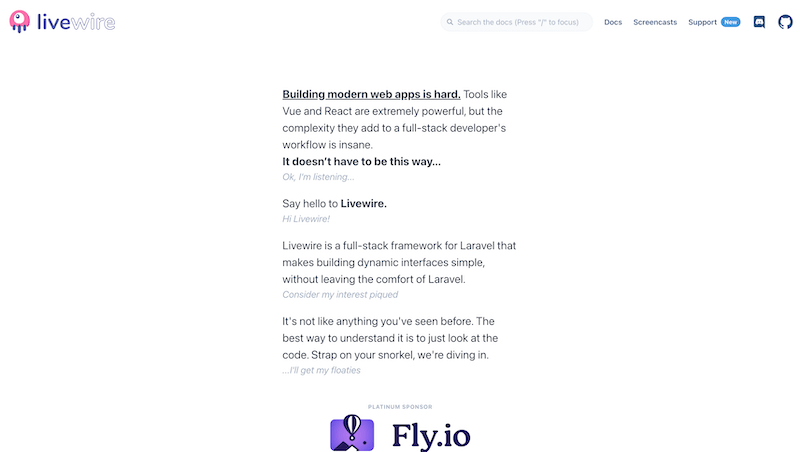
Laravel Livewire is interesting to me because it brings a lot of interactivity back into a world Laravel developers already understand. Not every application needs a separate frontend, a heavy build process, and a hard boundary between backend and client. Sometimes you just need a form that reacts without a full reload, a filter above a table, a modal, or an admin screen that feels faster to use.
Livewire makes it possible to build those parts without leaving the Laravel mental model. A component has state, renders a Blade view, and communicates with the server in a way that avoids the classic full request-response feeling for the user. The result can feel very natural when components stay under control.
Where Livewire fits best
Livewire makes the most sense to me in admin panels, internal tools, forms, filters, search interfaces, simple wizards, and parts of an application where faster interaction matters, but a full SPA would be unnecessary. The developer can stay close to Laravel while still giving the user a smoother interface.
It also fits teams that are stronger in PHP than in a large frontend stack. I do not see that as a weakness. It is a practical choice. If the project does not need a separate client application, Livewire can be a simpler, clearer, and cheaper path to a good result.
Components need boundaries
The risk with Livewire is not the tool itself, but the temptation to put everything into a component. State, validation, queries, business logic, permissions, and side effects can quickly end up in one place. At first that feels convenient. Later, the component can become harder to read than a traditional controller.
That is why I would use Livewire with discipline. The component should handle interaction and coordination, while more complex logic belongs in services, action classes, query objects, or the domain layer. When that boundary is respected, Livewire is pleasant to work with. When everything stays in the component, the advantage starts turning into debt.
Better UX without rebuilding the app
Livewire is strong because it gives a fast path to better UX. You do not have to rewrite the whole application or build a new frontend. You can improve one specific area: list filtering, form validation, inline actions, saving settings, or switching states. The user notices the difference, while the technical complexity stays reasonable.
That matters in projects that evolve over time. A big technology jump is not always the right answer. Sometimes it is better to add interactivity exactly where it helps and keep the rest of the application simple. Livewire fits that kind of gradual development very well.
What to watch out for
Livewire is not a replacement for thoughtful architecture. If a component loads too much data, sends large payloads, or has unclear boundaries, the problem will show up in both performance and maintenance. You still need to think about queries, pagination, debounce behavior, and what really needs to be synchronized with the server.
Used well, Livewire is one of the most practical tools in the Laravel ecosystem. It lets you build interactive areas quickly, without unnecessary technical weight, and with a strong connection to the backend. The best results come when components stay small, readable, and supported by the rest of the application.
hub Related tools
Explore similar tools
A random selection of tools from the same category.
Laravel Pint
Laravel Pint solves one quiet but important problem: the team no longer has to keep discussing PHP code formatting. It is built on top of PHP-CS-Fixer, ships with sensible Laravel defaults, and works well both for local fixes and CI checks. Its biggest value appears when code style stops being a code review topic.
Laravel Sanctum
Laravel Sanctum is a lighter authentication solution for Laravel applications that need to protect SPAs, mobile apps, or simple token-based APIs. Its strength is not replacing OAuth in every scenario, but practicality: it supports session authentication for first-party SPAs and personal API tokens with abilities for simpler integrations.
Pest PHP
Pest PHP is a modern testing framework for PHP with a simple and readable syntax. It is not only a nicer way to write tests, but a tool that lowers the friction of testing regularly and fits naturally into the Laravel ecosystem. It helps most when tests are a normal part of development, not a separate chore at the end.
add_circle Missing a tool?
Suggest a tool for the list
If you could not find a useful tool here, send me its name and URL. I will review it and consider adding it to the public catalog.
