Laravel Sanctum
Laravel Sanctum is a lighter authentication solution for Laravel applications that need to protect SPAs, mobile apps, or simple token-based APIs. Its strength is not replacing OAuth in every scenario, but practicality: it supports session authentication for first-party SPAs and personal API tokens with abilities for simpler integrations.
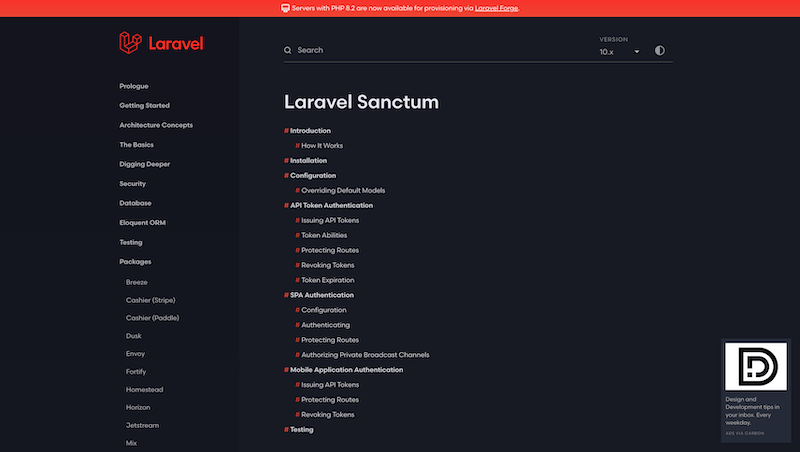
Laravel Sanctum is a tool I like mostly because it is pragmatic. Not every application needs a full OAuth solution, an authorization server, and a complex client flow. Often you only need to authenticate your own SPA, a mobile app, or allow a user to create a personal API token for a simple integration.
Sanctum covers exactly those common cases. On one side, it supports token authentication through personal access tokens. On the other, it supports session authentication for first-party SPAs. The important part is knowing which mode your project is using, because each one solves a different problem.
SPA authentication without unnecessary tokens
For a first-party SPA that belongs to the same application or ecosystem, Sanctum usually does not rely on bearer tokens stored in the frontend. It uses Laravel session authentication, cookies, and CSRF protection. That is a good thing, because frontend tokens add risk when they are not truly needed.
In practice, this means an application can have a modern frontend while still relying on familiar Laravel mechanisms. You do not need to reach for OAuth automatically just because the interface is an SPA. If the client is part of your own application, session-based authentication can be simpler and safer.
API tokens for simple integrations
The second part of Sanctum is API token management. A user can create a token and send it in the Authorization header as a bearer token. Tokens can have abilities, which limit what they are allowed to do. That is useful for personal access, internal scripts, simple integrations, and admin tools.
It is important not to underestimate that simplicity. A token is still an access key to the application. It needs a clear purpose, reasonable permissions, revocation, and in more sensitive projects a thoughtful expiration policy. Sanctum provides the mechanism, but the security rules still belong to the developer.
When Sanctum is enough
Sanctum makes sense in applications that do not need a full OAuth ecosystem. If you are dealing with your own SPA, a mobile app, or simple user API tokens, it is often more direct than heavier alternatives. It adds just enough infrastructure for common Laravel projects.
If you are building a public platform for third-party developers, need complex OAuth grants, external clients, and detailed application management, Sanctum may no longer be the right tool. At that point, it is better to use a solution designed specifically for full OAuth workflows.
What to watch out for
The most common problem with Sanctum is not being clear about which authentication mode is in use. SPA authentication and API tokens are not the same thing. When those worlds are mixed without a clear design, issues appear around CORS, cookies, CSRF protection, or unnecessarily exposed tokens.
Used correctly, Sanctum is very practical. It lets you stay with a simple Laravel solution that covers many everyday needs. It is not a universal security layer for everything, but for first-party SPAs and simple tokens it often gives the right balance of simplicity and control.
hub Related tools
Explore similar tools
A random selection of tools from the same category.
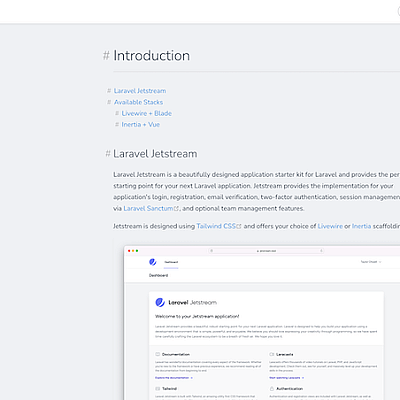
Laravel Jetstream
Laravel Jetstream is a starter kit for Laravel applications that need a ready-made foundation for login, registration, user profiles, two-factor authentication, session management, and optionally teams. It makes the most sense when you do not want to rebuild common application infrastructure from scratch, but still want to stay in the Laravel ecosystem and keep control over the result.
Rector
I see Rector as a tool for the point where manual refactoring stops making economic sense. It can scan a PHP codebase, apply mechanical changes, and help with language or framework upgrades without forcing a developer to hand-edit thousands of tiny details. Its real value appears when it is part of a controlled process, not blind automatic rewriting.
Pest PHP
Pest PHP is a modern testing framework for PHP with a simple and readable syntax. It is not only a nicer way to write tests, but a tool that lowers the friction of testing regularly and fits naturally into the Laravel ecosystem. It helps most when tests are a normal part of development, not a separate chore at the end.
add_circle Missing a tool?
Suggest a tool for the list
If you could not find a useful tool here, send me its name and URL. I will review it and consider adding it to the public catalog.
