Spatie
Spatie is best known for its long-maintained PHP and Laravel packages. In practice, I see it as a source of proven solutions for recurring problems: permissions, media handling, activity logs, backups, data objects, webhooks, and other application concerns. The value is not installing everything, but choosing the package that truly simplifies the project.
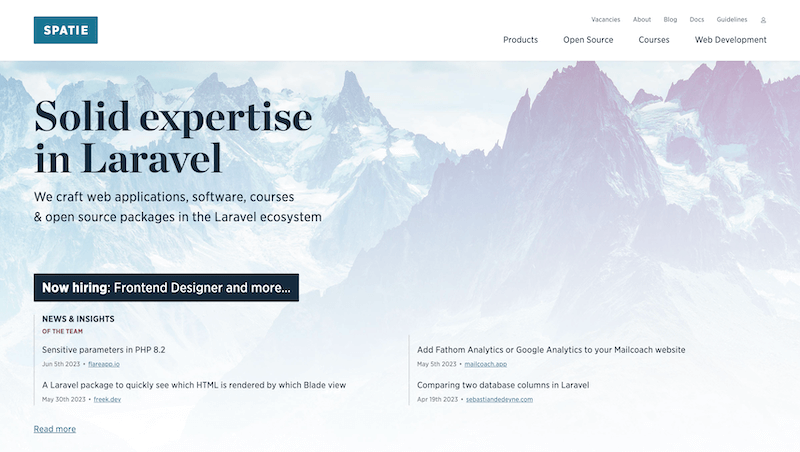
I do not see Spatie as one specific tool, but as an ecosystem of packages that most Laravel developers eventually encounter. Some of their packages have become almost standard solutions for common problems: permissions, media handling, activity logs, backups, data objects, webhooks, and various kinds of structured data.
The biggest value of Spatie is not that you can install a package for everything. The value is that many of their solutions are thoughtful, well documented, and maintained over time. For recurring application concerns, that often means less custom code, fewer edge-case mistakes, and a faster path to a stable result.
When to reach for a package
A package makes sense when it solves a problem that is not unique to your project. Role and permission management, media uploads, and activity logging are good examples. Each of these can be written by hand, but custom implementations often start simple and gradually accumulate exceptions.
If a high-quality package covers most of the need and can still be adjusted sensibly, it is often better to use it than to rediscover the same edges yourself. That does not mean giving up on your own architecture. It means deciding where custom code actually adds value.
Documentation and maintenance
With external packages, trust matters. It is not enough that a package works today. I want documentation, tests, community usage, a release process, and a reasonable chance that it will survive future Laravel and PHP versions. Spatie has built a strong reputation in that area.
Good documentation is a practical advantage. A new developer can understand the solution faster, the implementation is easier to hand over, and not everything has to be explained through custom code. For packages that touch important parts of the application, that can be just as important as the feature itself.
Do not install everything
A strong package ecosystem has another side. It is easy to add a dependency for a problem that could be solved with a few lines of local code. Every package brings an API, configuration, updates, and an opinion about how that part of the application should work.
That is why I would choose Spatie packages as carefully as any other dependency. If a package solves a complex and recurring area, it can make a lot of sense. If it only replaces a simple function, a local solution may be better. The point is not the number of packages, but the quality of the decision.
Practical impact on a project
In the right places, Spatie packages can speed up development significantly. They are especially useful in areas with many details but little domain uniqueness. Permissions, media, and activity logs are usually not the main product innovation. Still, they need to work reliably and remain maintainable.
Used thoughtfully, they let you focus your own energy where the project really matters: the domain, user workflows, and decisions that cannot be bought as a package. Spatie is a practical partner in that sense. Not a replacement for architecture, but a set of well-built building blocks.
hub Related tools
Explore similar tools
A random selection of tools from the same category.
Pest PHP
Pest PHP is a modern testing framework for PHP with a simple and readable syntax. It is not only a nicer way to write tests, but a tool that lowers the friction of testing regularly and fits naturally into the Laravel ecosystem. It helps most when tests are a normal part of development, not a separate chore at the end.
Rector
I see Rector as a tool for the point where manual refactoring stops making economic sense. It can scan a PHP codebase, apply mechanical changes, and help with language or framework upgrades without forcing a developer to hand-edit thousands of tiny details. Its real value appears when it is part of a controlled process, not blind automatic rewriting.
Laravel Pint
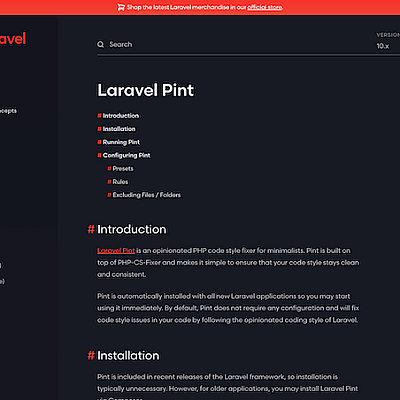
Laravel Pint solves one quiet but important problem: the team no longer has to keep discussing PHP code formatting. It is built on top of PHP-CS-Fixer, ships with sensible Laravel defaults, and works well both for local fixes and CI checks. Its biggest value appears when code style stops being a code review topic.
add_circle Missing a tool?
Suggest a tool for the list
If you could not find a useful tool here, send me its name and URL. I will review it and consider adding it to the public catalog.
