7 min read
What AI Took from Me and What It Gave Me
AI changed the way I develop software and find information in everyday life. A personal reflection on authorship, responsibility, privacy, and why working faster has not automatically given me more free time.
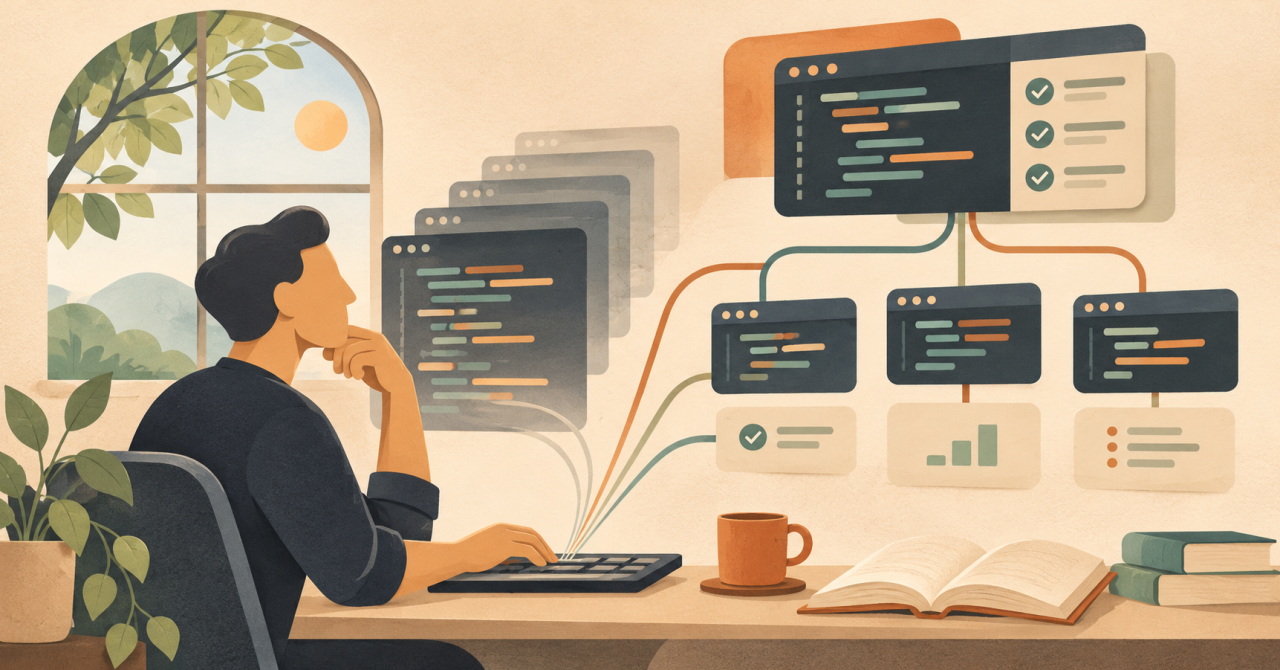
Just two or three years ago, I wrote practically all my code by hand. Today, AI agents produce a substantial part of it. I decide what needs to be built, guide the work along the way, and review the result. When a solution does not meet my requirements, I send it back for revision.
I could say that AI has taken my work away. More accurately, it has taken over certain activities and replaced them with others. I do not have less work. What has changed most is how I spend my time.
Gradually, it has also become part of my personal life. It helps me understand unfamiliar topics, summarize a video, find a cartoon for my little boy, or look for ideas for a trip. That has made me think about what this change has given me — and what I have lost along the way.
From completing lines to handing over tasks
My use of AI started fairly quietly. At first, it was mainly code completion in my editor. I was still doing the programming myself; the tool simply suggested what the next line or part of a function might look like.
Later, I moved on to agents such as Codex and Claude Code. I could give them a whole task and let them propose and implement a solution. Initially, I approached this cautiously and watched closely what they produced.
These days, I write much less code by hand. Of course, I still add or change a line occasionally, but a large part of my work involves assigning tasks, assessing proposals, and reviewing changes. Developers call that a code review: I go through the code and check whether it does what it should and meets the project's requirements.
This shift happened gradually. As I gained experience, I developed a better understanding of which tasks I could hand over to an agent and where it would need my guidance.
I do not miss the typing much. Sometimes I miss the authorship
Looking back, I do not miss writing code by hand as much as I might have expected. I do not feel the need to write every line myself.
What I sometimes miss is the satisfaction of solving a problem on my own. That moment when, after a lot of thought, the solution finally clicks. And the sense of authorship: knowing that I wrote all the code with my own hands.
Today, I contribute to the result differently. I still decide what should be built and which solution I will accept, but the agent often handles the implementation. The result may be exactly what I had in mind, yet it feels a little different.
That does not mean I want to return to my old way of working. I simply acknowledge that even a change that suits me in many ways can take something away.
The time I saved turned into more work
It might seem that letting AI handle part of development would automatically give me more free time. So far, it has worked differently for me. I use the time saved to start more tasks and projects. Overall, I get more work done than before. I also experienced what working with AI can make possible for a whole team during our shared development project at a team-building weekend.
Part of the reason is that, as a freelancer, I charge by the hour. Finishing a task faster does not, by itself, mean the same income and an extra afternoon off.
I try to follow a simple personal rule: I do not want to log time as though I had spent it working manually on something an agent was handling independently. At the same time, I value my time and expertise. Preparing a brief, making decisions about a solution, reviewing changes, and refining them are real work for which I take responsibility.
AI has therefore increased the amount of work I can handle. More time for family or rest has not followed automatically. In my case, the space it has freed up has mostly been filled with more tasks.
The hardest part is often switching my own attention
When I work with agents on several projects at once, switching my attention is often the challenging part.
Every project has different requirements, is at a different stage, and calls for different decisions. To assess a result meaningfully, I need to get back up to speed on what is being addressed and why.
This was more difficult for me at first. Gradually, I developed a system that helps me keep track of work happening in parallel. Switching between projects is no longer the obstacle it used to be.
Even so, it is one of the most noticeable changes in my work. I spend less time writing the code itself, but I still need focus to make good decisions.
Sometimes we work together throughout; sometimes I review the result
I do not use AI agents the same way for every task. For some, I follow their work as it happens. I can stop them in time, point out a mistaken assumption, or clarify which direction they should take.
At other times, I let an agent work independently, perhaps overnight. In the morning, I review the proposed solution, and we refine it based on what I find. The agent finishing its work does not mean the solution is ready to use. My review comes next.
I am gradually developing a feel for when my ongoing involvement is useful and when I can let the agent work on its own for longer.
But I cannot rely on it completely. Sometimes it takes a different direction from the one I intended. That is precisely why my own knowledge still matters. I need it to recognize when a result is good and when it merely looks convincing at first glance. I discuss my approach to setting boundaries and reviewing AI-generated work in more detail in a separate article.
It helps most when I am finding my feet
I see a major benefit in using AI to get acquainted with areas I do not yet understand. That might be a technology I have never worked with or an entirely different subject.
It helps me get my bearings more quickly. I can ask follow-up questions, request a simpler explanation, or ask for an example. I do not need to know the right terminology from the outset just to figure out what to search for.
I use it in a similar way in my personal life. I ask for summaries of videos and web pages, look for cartoons for my little boy, discuss products, or explore ideas for a trip.
I used to start most of these searches on Google. Today, I more often start with a conversation with AI. A work assistant has become a tool I also turn to for everyday questions.
I do not give it access to everything
The more often I use AI, the more important it becomes for me to know where I do not want to let it in.
My personal inbox, client communications, and client servers are not places an agent should automatically have access to. The fact that it could be useful there is not enough on its own.
In development, it helps that I use synthetic test data locally. I try to promote a workflow in which the production database containing real information is never copied into the development environment on a computer. Keeping test data separate from client data is also part of how I design our shared application foundation.
This reduces the risk of exposing real personal or client information while working with an agent. It does not address every privacy concern, but it creates a much better starting point for everyday development.
So what has AI taken from me, and what has it given me?
It has taken over a large part of writing code by hand. Along with that, I sometimes miss the satisfaction of solving a problem myself and the feeling that I created every detail on my own.
It has given me the ability to handle more work, take on more projects, and get to grips with unfamiliar topics more quickly. It has also brought different demands: giving clearer instructions, keeping the work on course, switching between tasks, and carefully assessing the results.
My work has not disappeared. It has changed.
Perhaps my clearest personal takeaway is that working faster does not automatically mean having more free time. AI helps me get more things done. But it will not decide for me how many of those things I take on or how much room I leave for life outside work.
Categories
You might also enjoy

From My Computer to the Team: Our First Shared Project with the Starter Kit
How I Design a Company CMS and a Shared Application Foundation with Laravel